A U.S. buyer’s guide to the sixth-generation RAV4, including FWD versus AWD, trim value, cargo space, towing, ownership costs, and whether the redesign is worth it
The redesigned 2026 Toyota RAV4 Hybrid begins the compact SUV’s sixth generation and marks a major change for U.S. shoppers: every regular RAV4 is now a hybrid. Front-wheel-drive models produce 226 horsepower, all-wheel-drive versions make 236 horsepower, and the most efficient trims are rated at up to 43 mpg combined.
The new model is quicker, more efficient, more technologically advanced, and more capable than the outgoing RAV4 Hybrid. It also remains a practical five-passenger SUV with a large cargo area and strong resale appeal. The tradeoff is that Toyota did not transform the cabin into a premium space, and the gasoline engine still becomes loud under hard acceleration.
Key Takeaways
| • The 2026 RAV4 is hybrid-only, with standard hybrid and plug-in hybrid powertrains replacing the former gasoline-only version.
• Toyota lists regular hybrid base MSRPs from $31,900 for the LE to $43,300 for the Limited, before destination and local charges. • FWD versions produce 226 horsepower and reach up to 43 mpg combined, while AWD models produce 236 horsepower. • Car and Driver recorded a 7.1-second 0-to-60-mph time and 36 mpg on its 75-mph highway test in a Limited AWD. • The RAV4 holds about 38 cubic feet of cargo behind the rear seat and up to 70 cubic feet with the rear seat folded. • Most AWD trims can tow up to 3,500 pounds, while FWD versions and the AWD LE have lower ratings. • The LE, SE, and XLE Premium are the strongest value trims; Limited costs more without fully delivering a luxury-grade interior. |
What Changed for the 2026 Toyota RAV4 Hybrid?
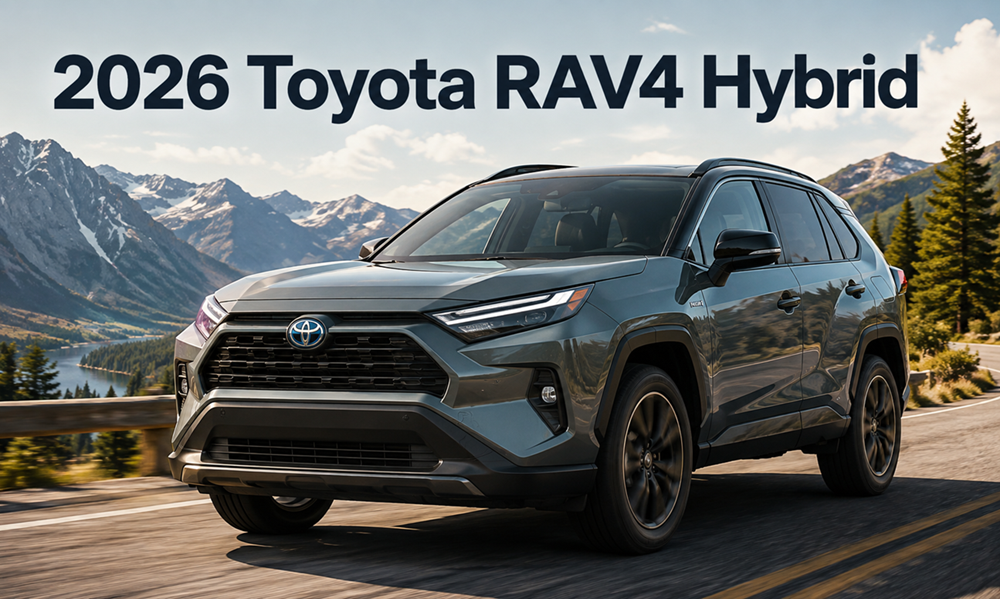
The exterior is more upright and angular, with Toyota’s hammerhead front design, sharper fenders, a flatter roofline, and wider-looking rear lighting. Toyota organizes the range into Core, Sport, and Rugged design themes rather than making every trim look nearly identical.
The powertrain receives a newer hybrid transaxle, revised motors, an updated power-control unit, and a lithium-ion battery. Front-wheel drive is now available, which helps lower the starting price and improves fuel economy. All-wheel-drive versions add an electric motor at the rear axle instead of using a mechanical driveshaft.
Inside, every trim receives a 12.3-inch digital gauge cluster and Toyota Safety Sense 4.0. The standard touchscreen measures 10.5 inches, while higher trims use a 12.9-inch display. The software is quicker and supports wireless Apple CarPlay and Android Auto.
| Area | 2025 RAV4 Hybrid | 2026 RAV4 Hybrid |
| Powertrain choice | Hybrid AWD only | Hybrid FWD or AWD, plus separate PHEV models |
| Combined horsepower | 219 hp | 226 hp FWD or 236 hp AWD |
| Best combined MPG | About 39 mpg | Up to 43 mpg |
| Standard gauge display | Smaller or trim-dependent | 12.3-inch digital display on every trim |
| Maximum towing | Up to 1,750 pounds on many hybrid versions | Up to 3,500 pounds on most AWD trims |
| Safety suite | Toyota Safety Sense 2.5 | Toyota Safety Sense 4.0 |
How Much Does the 2026 RAV4 Hybrid Cost?
Toyota lists six regular hybrid trims. The following figures are base MSRPs before destination, taxes, registration, documentation fees, accessories, and dealer pricing.
| Trim | Base MSRP | Drive Layout | Best Fit |
| LE | $31,900 | FWD or available AWD | Buyers wanting maximum efficiency and the lowest price |
| SE | $34,700 | FWD or available AWD | Drivers who prefer sportier styling without premium pricing |
| XLE Premium | $36,100 | FWD or available AWD | Best comfort and value balance for many families |
| Woodland | $39,900 | AWD | Outdoor buyers wanting all-terrain tires and rugged equipment |
| XSE | $41,300 | AWD | Shoppers wanting sport styling, larger technology, and premium features |
| Limited | $43,300 | AWD | Buyers prioritizing the most complete equipment list |
Current trim prices and equipment are available on Toyota’s official 2026 RAV4 page. Toyota’s base MSRP excludes delivery, processing and handling, so the amount shown on a window sticker or pricing guide will be higher.
The LE is no longer a bare-bones SUV. It includes the digital gauge cluster, a 10.5-inch touchscreen, wireless phone integration, blind-spot monitoring, rear cross-traffic alert, and the newest safety suite. XLE Premium adds comfort features that many families will use every day, making it the easiest all-around recommendation.
Which Trim Is the Best Value?
| Trim | Main Strength | Main Tradeoff |
| LE | Lowest price and best fuel economy | Cloth cabin and fewer convenience upgrades |
| SE | Sport appearance without requiring AWD | Style upgrades matter more than capability |
| XLE Premium | Heated seats, SofTex upholstery, power liftgate, parking support | Costs more than the efficient base trims |
| Woodland | All-terrain tires, roof hardware, fog lights, higher adventure appeal | Lower fuel economy and no serious low-range 4WD |
| XSE | Large screen, ventilated seats, sporty design, premium technology | Price approaches entry-luxury territory |
| Limited | Panoramic roof, JBL audio, dual wireless charging, top features | Cabin materials do not fully match the price |
Choose LE when fuel economy and affordability matter most. Choose SE when you want a more distinctive look without paying for luxury equipment. XLE Premium offers the most useful combination of comfort, technology, and price.
Woodland makes sense for drivers who regularly use dirt roads, trailhead parking, snowy access roads, or roof-mounted gear. XSE and Limited are attractive for buyers who want nearly every feature, but their pricing makes interior quality and competitor comparisons more important.
How Quick Is the New RAV4 Hybrid?
The 2026 RAV4 Hybrid is not a performance SUV, but it is responsive enough for daily traffic. The electric motors provide immediate low-speed assistance, helping the vehicle pull away smoothly without waiting for the engine to build power.
Car and Driver’s Limited AWD reached 60 mph in 7.1 seconds and completed the quarter-mile in 15.3 seconds at 92 mph. That is slightly quicker than the previous RAV4 Hybrid and competitive with the Honda CR-V Hybrid.
The weak point is engine refinement. Under firm acceleration, the four-cylinder can sound coarse and remain at high revs. Car and Driver measured 75 decibels at full throttle, louder than the CR-V Hybrid it compared against. At a steady 70 mph, the cabin settled to a more reasonable 69 decibels.
| Test Result | 2026 RAV4 Limited AWD |
| 0 to 60 mph | 7.1 seconds |
| Quarter-mile | 15.3 seconds at 92 mph |
| 50 to 70 mph | 5.1 seconds |
| 70 to 0 mph braking | 179 feet |
| Observed fuel economy | 34 mpg |
| 75-mph highway fuel economy | 36 mpg |
| Estimated highway range | 520 miles |
What Fuel Economy Can Buyers Expect?
The most efficient LE, SE, and XLE Premium FWD configurations are rated at 47 mpg city, 40 mpg highway, and 43 mpg combined. AWD models generally return 41 or 42 mpg combined, depending on trim. Woodland is rated lower because of its tires, ride height, and rugged equipment.
| Configuration | EPA or Toyota Rating | Best For |
| Efficient FWD trims | 47 city / 40 highway / 43 combined | Urban and suburban commuters |
| Typical AWD trims | About 41 to 42 combined | Drivers wanting added traction |
| Woodland AWD | About 38 combined | Outdoor use where rugged equipment matters more than maximum MPG |
| Limited AWD highway test | 36 mpg at 75 mph | A realistic high-speed road-trip reference |
A buyer who spends most of the year on dry, maintained roads may save money twice with FWD: the vehicle costs less and uses less fuel. AWD is still valuable in snow, on steep roads, and for drivers who want the higher towing capacity available on most AWD trims.
Should You Choose FWD or AWD?
| Choose FWD If You… | Choose AWD If You… |
| Want the lowest price and highest fuel economy | Regularly drive in snow, heavy rain, or on steep roads |
| Live in a mild climate | Need up to 3,500 pounds of towing on a qualifying trim |
| Mostly use paved suburban and highway routes | Frequently reach campsites, cabins, or unpaved parking areas |
| Prefer fewer driven components and slightly less weight | Accept a small fuel-economy penalty for added traction |
AWD does not replace good tires. Drivers in severe winter regions should budget for appropriate all-season or winter tires regardless of drivetrain. Woodland’s all-terrain tires offer a different compromise, improving loose-surface capability while reducing efficiency and potentially increasing road noise.
How Practical Is the Interior and Cargo Area?
The RAV4 remains one of the easier compact SUVs to use. Adults fit comfortably in both rows, the rear doors provide practical access, and the dashboard places major controls within reach. The high seating position and upright windows also help outward visibility.
Cargo space measures about 38 cubic feet behind the rear seats and approximately 70 cubic feet with them folded. Car and Driver fit 10 carry-on suitcases behind the rear seat and 24 with the seat folded.
The cabin’s weakness is material quality. Storage is plentiful and the displays are modern, but hard plastics remain visible even in the Limited. Buyers spending more than $45,000 after options should compare the RAV4 directly with the Honda CR-V Hybrid, Mazda CX-50 Hybrid, and higher trims of the Hyundai Tucson Hybrid.
Can the 2026 RAV4 Hybrid Tow a Trailer?
Most AWD versions are rated to tow up to 3,500 pounds, a significant improvement over the previous hybrid. Front-wheel-drive models and the AWD LE are limited to 1,750 pounds.
The higher rating can cover many small campers, utility trailers, lightweight boats, and recreational equipment. Buyers must still account for trailer tongue weight, passengers, cargo, accessories, and the payload label on the exact vehicle. Trailer brakes and correct towing equipment may also be required.
What Technology and Safety Features Are New?
A 12.3-inch digital gauge cluster is standard across the lineup. The 10.5-inch infotainment system supports wireless Apple CarPlay and Android Auto, while XSE and Limited receive a 12.9-inch screen. Available features include a head-up display, 360-degree camera, Advanced Park, dual wireless chargers, a 1,500-watt cargo-area outlet, and Traffic Jam Assist.
Toyota Safety Sense 4.0 is standard and updates the vehicle’s camera, radar, detection range, and control software. The suite includes automatic emergency braking with pedestrian detection, lane-departure alert, lane-tracing assistance, adaptive cruise control, road-sign assistance, and automatic high beams.
What Warranty Coverage Does Toyota Include?
Toyota provides a 3-year or 36,000-mile basic warranty and a 5-year or 60,000-mile powertrain warranty. ToyotaCare covers scheduled maintenance for 2 years or 25,000 miles and includes roadside assistance for the initial coverage period.
Toyota’s hybrid warranty information states that the hybrid battery is covered for 10 years or 150,000 miles, whichever comes first. Other hybrid drive components generally carry separate 8-year or 100,000-mile coverage, subject to the warranty guide’s terms.
Is the 2026 Model Worth Buying Over a 2025 RAV4 Hybrid?
| Buy the 2026 Model If You… | Consider a 2025 Model If You… |
| Want FWD, higher horsepower, and improved MPG | Find a meaningful discount or lower used price |
| Need newer infotainment and Safety Sense 4.0 | Prefer the proven final year of the older generation |
| Want up to 3,500 pounds of towing | Do not need the new towing or technology upgrades |
| Plan to keep the SUV for many years | Want to reduce first-year redesign risk |
| Prefer the new styling and trim choices | Value price more than the newest design |
The redesign is worthwhile for shoppers who will use its efficiency, towing, technology, and extra power. A discounted 2025 RAV4 Hybrid remains appealing because the older model already delivered excellent fuel economy, proven practicality, and a long market history.
Frequently Asked Questions
How much is the 2026 Toyota RAV4 Hybrid?
Toyota lists base MSRPs from $31,900 for the LE to $43,300 for the Limited before destination, options, taxes, and dealer charges.
Is every 2026 RAV4 a hybrid?
Yes. The U.S. lineup uses either a conventional hybrid or a plug-in hybrid powertrain. There is no gasoline-only 2026 RAV4.
How much horsepower does the regular hybrid have?
FWD models produce 226 combined horsepower, while AWD versions produce 236 horsepower.
What is the best MPG for the 2026 RAV4?
The most efficient FWD configurations are rated at 47 mpg city, 40 highway, and 43 combined.
How fast is the RAV4 Hybrid?
Car and Driver recorded a 7.1-second 0-to-60-mph time in a Limited AWD.
How much can it tow?
Most AWD trims can tow up to 3,500 pounds. FWD models and the AWD LE are rated at 1,750 pounds.
Which trim is the best value?
XLE Premium offers the strongest balance for many families, while LE is best for efficiency and SE is a good lower-cost style upgrade.
Does the RAV4 Hybrid need to be plugged in?
No. The regular hybrid charges through the engine and regenerative braking. Only the separate RAV4 Plug-in Hybrid uses external charging.
The Bottom Line
The 2026 Toyota RAV4 Hybrid is a stronger vehicle than the model it replaces. It is quicker, more efficient, better equipped, and more capable, while keeping the rear-seat and cargo practicality that made the RAV4 popular.
It is not the most refined compact hybrid SUV. The engine becomes noisy during hard acceleration, the handling is ordinary, and the cabin materials can disappoint in expensive trims. For value, the LE, SE, and XLE Premium are the most convincing versions. Buyers choosing XSE or Limited should compare rivals carefully before paying the higher out-the-door price.