A value-first U.S. buyer guide to the XL trim, hybrid and EcoBoost choices, AWD, towing, bed utility, safety, and whether XLT is worth the step up
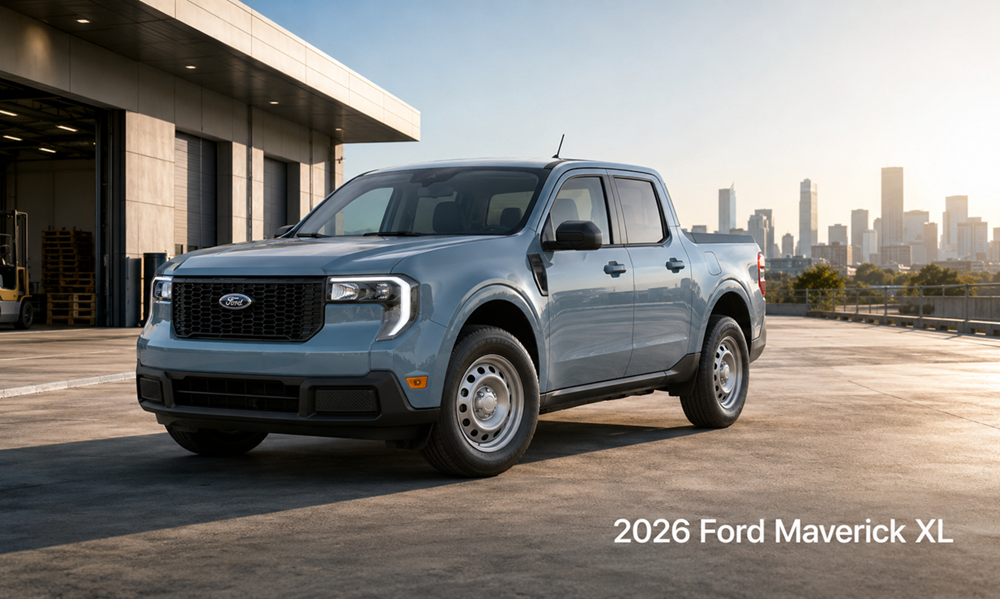
The 2026 Ford Maverick XL is easy to misunderstand if you judge it only by the word “base.” It has steel wheels, a manual tailgate lock, single-zone manual climate control, and a cabin that makes no attempt to imitate a luxury crossover. At the same time, it comes with a 13.2-inch touchscreen, wireless Apple CarPlay and Android Auto, a standard hybrid powertrain, five-passenger seating, a genuinely useful 4.5-foot bed, and the ability to tow up to 4,000 pounds when configured correctly.
For 2026, Ford also made the XL more interesting by bringing back a front-wheel-drive 2.0-liter EcoBoost version at a lower price than the standard hybrid. That creates several very different Mavericks under the same XL badge. One is an efficiency-focused city truck. Another is a cheaper turbo work truck. A third combines hybrid fuel economy with all-wheel drive. The smartest choice depends less on horsepower than on what you plan to carry, tow, and spend on fuel.
| The quick answer
The Maverick XL remains one of the strongest low-cost new-truck values in the U.S. market, especially as a front-wheel-drive hybrid. The catch is that adding AWD, the 4K Tow Package, driver-assistance packages, bed accessories, and dealer options can push an XL close enough to XLT pricing that the upgrade deserves a fresh comparison. |
Key Takeaways
- Ford lists the 2026 Maverick XL hybrid FWD at $28,145 before destination. The returning EcoBoost FWD version is priced $1,000 lower, while Car and Driver lists $29,990 for the hybrid XL when destination is included.
- The standard 2.5-liter hybrid delivers 191 combined horsepower and an EPA-estimated 42 mpg city, 35 highway, and 38 combined with front-wheel drive.
- The available 2.0-liter EcoBoost produces 250 horsepower and 275 lb-ft of torque and can be paired with FWD or AWD on the XL.
- Hybrid AWD is available on the XL, giving efficiency-focused buyers an all-weather option that did not exist on early Maverick model years.
- Base towing is 2,000 pounds. With AWD and the available 4K Tow Package, both hybrid and EcoBoost configurations can tow up to 4,000 pounds.
- Maximum payload reaches 1,500 pounds on hybrid FWD and EcoBoost FWD/AWD configurations. Hybrid AWD is rated up to 1,400 pounds.
- The XL has a 4.5-foot bed with 33.3 cubic feet of cargo volume and Ford’s FLEXBED system, making it better suited to light hauling than its compact exterior suggests.
- Before purchase, check the exact VIN for open recalls. Certain 2026 Mavericks are included in recent federal safety campaigns, including some hybrid models and a smaller population involving front lower control arm ball-joint assembly.
First Decision: What Does the 2026 Maverick XL Actually Cost?
Maverick pricing can look inconsistent online because different sources handle destination charges and engine pricing differently. Ford’s 2026 model information lists the standard hybrid XL at $28,145 MSRP before destination. For 2026, the 2.0-liter EcoBoost FWD configuration returned at a $1,000 discount versus the standard hybrid FWD, which puts its vehicle MSRP at $27,145 before destination.
Car and Driver lists the 2026 Maverick XL at $29,990. That figure aligns with the standard hybrid’s MSRP after Ford’s destination charge is included. When comparing dealer listings, use the window sticker and out-the-door price rather than assuming that two advertised base prices include the same fees.
| Configuration | Approx. Starting Vehicle MSRP | What It Means |
| XL EcoBoost FWD | $27,145 before destination | Lowest-cost route into a 2026 Maverick |
| XL Hybrid FWD | $28,145 before destination | Standard configuration and efficiency leader |
| Car and Driver base listing | $29,990 | Hybrid XL with destination reflected in listed MSRP |
| XLT starting MSRP | $29,645 before destination | Only $1,500 above the standard hybrid XL before options |
Current factory pricing and equipment can be checked on Ford’s official 2026 Maverick XL page. Dealer discounts, regional incentives, taxes, registration, accessories, and financing can change the final transaction price.
Second Decision: Hybrid or EcoBoost?
The Maverick XL is unusual because the cheaper engine is not the fuel-saving one. Ford makes the hybrid the standard powertrain, while the returning front-drive EcoBoost undercuts it by $1,000. That means choosing the engine is really a decision about operating costs, performance, and drivetrain needs.
| 2.5L Hybrid | 2.0L EcoBoost | |
| Output | 191 combined hp, 155 lb-ft engine torque | 250 hp, 275 lb-ft |
| Transmission | Power-split electronic CVT | 8-speed automatic |
| Drivetrain on XL | FWD standard, AWD optional | FWD or AWD |
| Best efficiency | 42 city / 35 highway / 38 combined mpg with FWD | Lower than hybrid, but more power |
| Base towing | 2,000 lb | 2,000 lb |
| Max towing | 4,000 lb with AWD and 4K Tow Package | 4,000 lb with AWD and 4K Tow Package |
| Best buyer | Commuters, city drivers, high annual mileage | Drivers who want quicker acceleration or prefer a conventional automatic |
When Is the Hybrid the Better Buy?
Choose the hybrid if most of your miles happen in traffic, suburbs, or mixed commuting. The front-drive hybrid’s EPA estimate of 42 mpg city is the figure that makes the Maverick fundamentally different from a traditional compact or midsize pickup. It can also reduce fuel stops for owners who use the truck as their only daily vehicle.
The 2026 lineup removes one of the old compromises because hybrid AWD is now available. That means buyers in snow-belt states no longer have to choose the turbo engine solely to get all-wheel drive. Hybrid AWD does give up a little payload, with Ford listing a 1,400-pound maximum instead of 1,500 pounds for hybrid FWD.
For current EPA ratings by drivetrain, use the U.S. Department of Energy fuel-economy database and search the exact 2026 Maverick configuration you are considering.
When Does the EcoBoost Make More Sense?
The EcoBoost makes sense for three buyers. First, shoppers trying to reach the lowest possible entry price can choose the returning FWD turbo configuration. Second, drivers who value stronger acceleration will notice the extra power and torque immediately. Third, buyers who simply prefer the feel of a conventional eight-speed automatic may find the EcoBoost more natural than the hybrid’s power-split transmission.
The main penalty is fuel economy. A small pickup can still be efficient with the turbo engine, but the hybrid is the version that delivers the Maverick’s headline fuel-saving advantage.
Third Decision: Do You Really Need AWD?
AWD is useful, but it is not automatically necessary because the Maverick’s front-wheel-drive layout gives it predictable traction for ordinary commuting. Drivers in regions with frequent snow, steep unpaved roads, muddy job sites, or boat ramps have a stronger case for AWD. Buyers in warm, flat areas may save money and fuel by staying with FWD.
AWD also becomes important if towing is part of the plan. Ford requires AWD with the 4K Tow Package to unlock the 4,000-pound maximum trailer rating. Without that package, the Maverick is rated for 2,000 pounds.
| The configuration trap
Do not assume that every AWD Maverick can tow 4,000 pounds. The 4K rating requires the correct AWD configuration and the 4K Tow Package. Always verify the individual truck’s window sticker and trailering label. |
Can the Maverick XL Work as a Real Pickup?
The answer depends on what “real pickup” means. The Maverick uses unibody construction rather than the separate frame used by an F-150 or Ranger, and its bed is only 4.5 feet long. It is not designed for fifth-wheel towing, heavy commercial payloads, or repeated large-trailer duty. For home improvement, bikes, landscaping supplies, camping gear, small-business equipment, and light trailers, however, the size is often an advantage.
| Utility Measure | 2026 Maverick XL |
| Bed length | 4 ft 5 in |
| Bed cargo volume | 33.3 cu ft |
| Width between wheel wells | 42.6 in |
| Overall bed width | 53.3 in |
| Maximum payload | Up to 1,500 lb |
| Hybrid AWD max payload | Up to 1,400 lb |
| Base towing | 2,000 lb |
| Maximum available towing | 4,000 lb |
| Seating | 5 |
The FLEXBED system is a major part of the XL’s value. Ford designed the bed with slots, tie-down points, and power access that make it easier to create dividers, supports, bike solutions, and do-it-yourself storage. A low bed floor and compact exterior also make loading less awkward than with many full-size pickups.
What Do You Give Up by Choosing the XL?
The XL is intentionally simple. Its standard 17-inch steel wheels, manual-folding mirrors with manual glass adjustment, manual tailgate lock, and single-zone manual climate control make the cost-cutting visible. For a work vehicle, that simplicity can be a benefit. For a daily driver, some buyers will quickly start adding options that narrow the price gap to XLT.
The surprise is that the technology basics are not stripped out. XL includes a 13.2-inch center display, an 8-inch cluster display, SYNC 4, wireless Apple CarPlay and Android Auto, cruise control, remote keyless entry, power windows and locks, and a rear bench with flip-up under-seat storage.
Is XLT Worth the Extra Money?
Ford lists the XLT at $29,645 before destination, only $1,500 above the standard hybrid XL’s vehicle MSRP. That does not mean every buyer should upgrade, because the XLT can also tempt you into more packages and a higher transaction price. Still, the small starting gap makes it worth comparing both trims rather than assuming XL is automatically the value winner.
| Question | Stay With XL | Consider XLT |
| Primary goal | Lowest purchase price | More convenience without going luxury |
| Wheels | Steel wheels are fine | Prefer upgraded appearance |
| Tailgate and mirrors | Manual hardware is acceptable | Convenience matters every day |
| Options | Need few extras | Already planning several XL add-ons |
| Ownership use | Work truck, fleet, basic commuter | Personal daily driver |
Three Maverick XL Builds That Make Sense
1. The Fuel-Saver: Hybrid FWD
This is the purest Maverick formula. Keep the standard hybrid, keep front-wheel drive, avoid expensive cosmetic options, and use the truck as an efficient commuter with an open cargo bed. It is the configuration most likely to deliver the lowest long-term fuel cost and the clearest reason to choose a Maverick over a traditional pickup.
2. The Budget Turbo: EcoBoost FWD
The 2026 EcoBoost FWD is for buyers who want the lowest published vehicle MSRP and stronger acceleration. It loses the hybrid’s headline fuel economy but still keeps the Maverick’s compact dimensions, useful bed, five-seat cabin, and 1,500-pound maximum payload.
3. The Mini Tow Rig: AWD Plus 4K Tow Package
If a small camper, utility trailer, personal watercraft, or lightweight boat is part of the ownership plan, configure AWD with the 4K Tow Package. Both the hybrid and EcoBoost can reach the 4,000-pound maximum in the correct configuration. The key is checking payload and tongue weight at the same time, because passengers and cargo use part of the truck’s available carrying capacity.
What Safety Tech Comes Standard on the XL?
The 2026 XL includes several important driver-assistance features even before adding the optional Ford Co-Pilot360 package. Ford lists Pre-Collision Assist with Automatic Emergency Braking, a Lane-Keeping System, automatic high beams, a rearview camera, and post-collision braking among the standard equipment.
The available Co-Pilot360 package adds more driver-assistance content, so buyers who spend a lot of time on highways should price the truck both with and without that package before deciding whether the XLT becomes the better overall value.
Are There Any 2026 Maverick Recalls Buyers Should Know About?
Yes, and recall applicability is VIN-specific. In 2026, NHTSA published a recall covering certain 2025 to 2026 Maverick hybrids because the transmission may not fully lock into Park in some situations. Ford’s remedy is a software update, including an over-the-air option for affected vehicles.
A separate 2026 campaign covers a much smaller population of 2022 to 2026 Mavericks with an improperly assembled or repaired front lower control arm ball joint that could separate and affect vehicle control. The existence of a model-year recall does not mean every 2026 Maverick is affected.
Before taking delivery, enter the exact VIN in the NHTSA recall lookup and ask the dealer to confirm that any open recall has a completed remedy. Federal safety recall repairs are performed at no charge.
What Warranty Does the 2026 Maverick XL Include?
- 3 years or 36,000 miles of bumper-to-bumper coverage.
- 5 years or 60,000 miles of powertrain coverage.
- 5 years or 60,000 miles of roadside assistance.
- 8 years or 100,000 miles of coverage for specified hybrid unique components when equipped with the hybrid powertrain.
Warranty terms have exclusions and conditions, so the warranty guide controls over a summary. Buyers planning heavy accessory use should also verify how dealer-installed and third-party modifications affect coverage.
Who Should Buy a 2026 Maverick XL?
- Buy it if you want pickup-bed usefulness without full-size pickup dimensions.
- Buy the hybrid FWD if fuel economy and daily commuting matter more than maximum acceleration.
- Choose hybrid AWD if you want strong efficiency plus better all-weather traction.
- Choose EcoBoost FWD if the lowest entry price and 250 horsepower matter more than hybrid mpg.
- Add AWD and the 4K Tow Package if your trailer genuinely exceeds 2,000 pounds.
- Price an XLT before signing if your XL build has accumulated several convenience packages and accessories.
Who Should Skip the XL?
Skip the XL if you want a quiet, richly trimmed cabin, power-adjustable convenience features, or a long list of comfort upgrades from the start. It is also the wrong truck for buyers who routinely tow more than 4,000 pounds or need the payload, bed length, and frame-based durability of a larger pickup.
For heavier towing, a Ford Ranger or another midsize pickup is the more appropriate starting point. For shoppers who never use an open bed, a compact hybrid crossover can offer better rear-seat comfort and covered cargo security.
Frequently Asked Questions
How much is a 2026 Ford Maverick XL?
Ford lists the standard hybrid XL at $28,145 before destination. The 2026 EcoBoost FWD configuration is $1,000 less at $27,145 before destination. Car and Driver lists $29,990 for the base hybrid XL with destination reflected in the published MSRP.
Is the 2026 Maverick XL hybrid standard?
Yes. The 2.5-liter hybrid with front-wheel drive is the standard powertrain. Hybrid AWD, EcoBoost FWD, and EcoBoost AWD are available configurations on the XL.
Can a 2026 Maverick XL hybrid have AWD?
Yes. The 2026 XL offers AWD with the hybrid powertrain. Ford lists maximum payload at 1,400 pounds for hybrid AWD versus 1,500 pounds for hybrid FWD.
Can the Maverick XL tow 4,000 pounds?
Yes, when equipped with AWD and the available 4K Tow Package. Without the package, the standard tow rating is 2,000 pounds. Always verify the individual truck’s rating and account for payload, passengers, cargo, and trailer tongue weight.
Does the Maverick XL have Apple CarPlay?
Yes. The 2026 XL includes a 13.2-inch SYNC 4 touchscreen with wireless Apple CarPlay and Android Auto compatibility.
Is the XL too basic for daily driving?
That depends on your priorities. The cabin uses basic materials and manual climate control, but it still includes modern infotainment, cruise control, power windows and locks, remote keyless entry, and useful cabin storage. Drivers who care about upgraded trim and convenience features should compare the XLT before buying.
Final Verdict: The XL Is Best When You Resist Overbuilding It
The 2026 Ford Maverick XL works because it does several expensive things cheaply. It gives buyers a new pickup bed, five seats, modern phone integration, a standard hybrid option, available AWD, and up to 4,000 pounds of towing without forcing them into a midsize or full-size truck.
Its value is strongest in simple configurations. The hybrid FWD model is the efficiency play. The EcoBoost FWD model is the price-and-power play. An AWD 4K Tow build adds legitimate small-trailer capability. Once an XL is loaded with enough packages to approach a similarly equipped XLT, however, the reason for choosing the base trim becomes less convincing.
For most U.S. buyers who need light-duty truck utility rather than maximum truck capacity, that is the Maverick XL’s real strength in 2026: it lets you buy only as much pickup as you actually need.
Research note: Pricing, equipment, towing, payload, fuel-economy context, warranty information, and recall details were checked against Ford, NHTSA, and the supplied Car and Driver reference using information available in August 2026. MSRP, destination charges, incentives, dealer inventory, option availability, EPA ratings, and recall status can change. Verify the exact window sticker and VIN before purchase.