
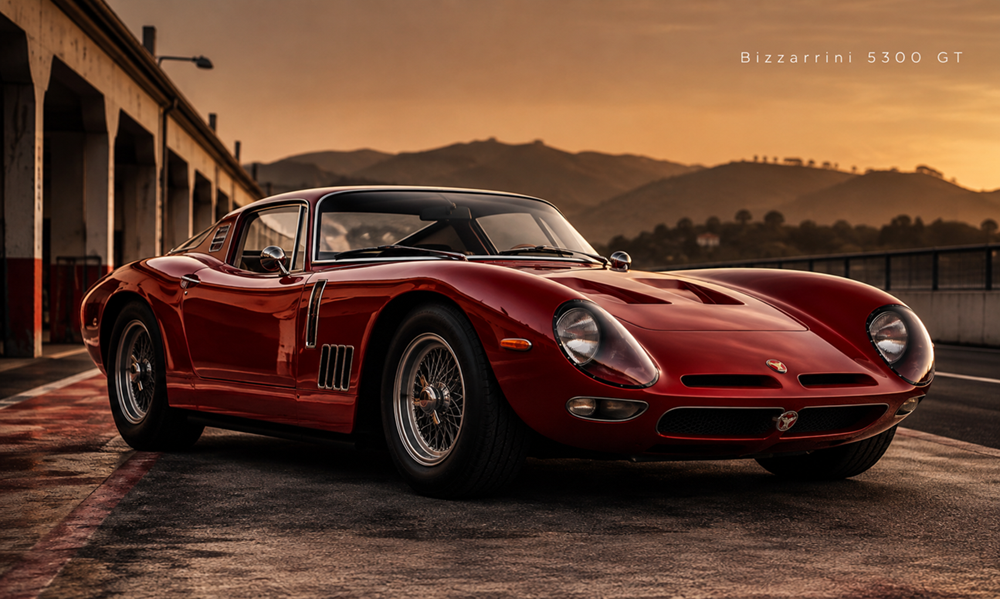
A heritage-first look at the new 5300 Aperta Lusso, its V8 engineering, hand-built luxury, 1960s roots, and collector significance
The Bizzarrini 5300 GT has always lived in a rare corner of automotive history. It combined Italian engineering and styling with Chevrolet V8 power, raced successfully at Le Mans, and disappeared after only a short production run. In 2026, Bizzarrini is revisiting that formula in a way that is more ambitious than a restoration or continuation car.
The new Bizzarrini 5300 Aperta Lusso is an open-top interpretation of the 5300 GT that Giorgetto Giugiaro and Giotto Bizzarrini had imagined more than 60 years ago but never put into production. It preserves the low, wide visual language of the original while using a carbon-fiber composite structure, modern fuel injection, contemporary weather sealing, discreet smartphone connectivity, and bespoke materials. Only 10 initial examples are planned, each commissioned individually.
| Why this car matters
The Aperta Lusso is not simply a roofless version of a continuation 5300 GT. Bizzarrini calls it the first all-new production car from the marque since the 1960s, making it a bridge between the original company and its modern revival. |
Key Takeaways
- The 5300 Aperta Lusso revives an open-top concept associated with Giorgetto Giugiaro and Giotto Bizzarrini that remained unrealized for more than six decades.
- Bizzarrini plans an initial run of 10 individually commissioned cars, with additional commissioning slots expected and customer cars arriving in 2027.
- Power comes from a front-mid-mounted 5.3-liter V8 producing well over 400 bhp, paired as standard with a Tremec TKX five-speed manual and a limited-slip differential.
- Bizzarrini says top speed exceeds 175 mph. A six-speed manual can also be specified for buyers who want greater high-speed refinement.
- The body is a single-piece carbon-fiber composite structure reinforced through the transmission tunnel with aerospace-grade steel to restore and exceed the torsional rigidity of the 1960s coupe.
- The cabin mixes hand-trimmed leather, Zegna fabric, European maple, air conditioning, MagSafe charging, CarPlay-compatible audio, and frameless windows with modern sealing.
- Pricing has not been publicly announced. Because each car is a bespoke commission and production is extremely limited, conventional MSRP comparisons are not especially meaningful.
- The original 5300 GT remains highly collectible. A 1968 alloy-bodied 5300 GT Strada sold for $915,250 at RM Sotheby’s Monterey auction in 2023, illustrating the strong collector market around authentic period cars.
The Story Starts Before the New Car
To understand the new Aperta Lusso, it helps to understand why the original 5300 GT matters. Giotto Bizzarrini was one of the most influential engineers of Italy’s postwar performance era. His work touched Ferrari’s 250 GTO program, and he later developed the V12 that became central to Lamborghini’s early identity.
After leaving Ferrari, Bizzarrini worked with Iso and helped create the Iso Grifo A3/C. That competition car evolved into the Bizzarrini 5300 GT after Giotto Bizzarrini and Iso founder Renzo Rivolta went their separate ways. The recipe was unconventional and effective: a Chevrolet small-block V8 sat far back behind the front axle, while the body carried dramatic proportions created around Giugiaro’s early Bertone design work.
1965: The Le Mans result that defined the name
The competition version proved that the design was more than sculpture. Bizzarrini’s 5300 GT Corsa won its class at the 1965 24 Hours of Le Mans and finished ninth overall. Bizzarrini later drove the car home to Livorno, reinforcing the dual-purpose identity that has followed the model ever since: race-bred engineering that could still live on the road.
Bizzarrini’s current 5300 GT Corsa Revival page preserves that 1965 competition story and describes the revival model built around the Le Mans-winning specification.
The Lost Open-Top Idea Finally Reaches Production
The new car’s most important historical detail is the roof. During the early 1960s, Giugiaro explored an open-top design using removable roof panels and a structural arch rather than a conventional folding soft top. The concept fit Bizzarrini’s engineering mindset because it promised open-air driving without abandoning the visual strength of the coupe.
The original company was focused heavily on racing, and the open-top idea never progressed into series production before Bizzarrini shut down in 1969. The drawings remained in the archive. The reborn company has now used that idea as the basis for the Aperta Lusso, retaining the central arch and adding two carbon-fiber roof panels that can be removed by one person and stored in the luggage compartment.
That makes the car closer in concept to a carefully engineered targa than to a traditional roadster. The structure is visible, functional, and closely tied to the old design rather than being added simply for modern crash aesthetics.
How Modern Is the New Bizzarrini 5300 GT Underneath?
Visually, the Aperta Lusso is intentionally rooted in the 1960s. Structurally, it is far more contemporary. Bizzarrini describes the body as a single-piece carbon-fiber composite structure, one of the largest of its type. Instead of placing a classic-looking body over a conventional modern platform, the structure itself is part of the engineering solution.
| Component | 2026 Bizzarrini 5300 Aperta Lusso |
| Body structure | Single-piece carbon-fiber composite semi-monocoque |
| Roof | Two removable carbon-fiber panels |
| Chassis reinforcement | Aerospace-grade steel transmission-tunnel structure plus cross-body reinforcement |
| Engine | 5.3-liter front-mid-mounted V8 |
| Output | Well over 400 bhp |
| Transmission | Tremec TKX five-speed manual; six-speed manual optional |
| Driven wheels | Rear, through a limited-slip differential |
| Top speed | More than 175 mph |
| Front suspension | Double wishbone with adjustable Koni dampers |
| Rear suspension | Double wishbone with adjustable Koni dampers |
| Brakes | Ventilated discs, four-piston Alcon front calipers, two-piston Brembo rear calipers |
| Wheels | Cast-magnesium Campagnolo center-lock wheels |
| Exhaust | Hand-fabricated valved Inconel system |
Why Keep a 5.3-Liter V8 Instead of Using a New Exotic Engine?
The V8 is central to the 5300 GT’s identity. The original car famously used Chevrolet small-block power because Bizzarrini valued durability, torque, parts availability, and a relatively compact engine package. The modern Aperta Lusso stays with the same basic displacement concept, placing the engine entirely behind the front axle centerline to support balanced weight distribution.
Bizzarrini has not chased a four-figure horsepower number. Output is stated at well over 400 bhp, which sounds modest beside modern hypercars but suits the project’s intent. This car is meant to emphasize mechanical involvement, low mass, manual shifting, steering feel, and sound rather than straight-line numbers alone.
Modern port fuel injection improves cold starts and day-to-day drivability. The system is deliberately styled to resemble carburetors when viewed in the engine bay. The hand-built Inconel exhaust includes catalytic converters and valves, allowing a more subdued note at idle and a stronger sound under load.
The Steering and Brakes Are Deliberately Old-School
One of the most interesting engineering choices is what Bizzarrini did not add. The braking system uses ventilated discs and modern calipers, but there is no brake servo. The goal is to preserve a direct relationship between pedal pressure and braking force.
The steering moves from the original car’s steering box to rack and pinion, but assistance is electrohydraulic and applied at the rack. Bizzarrini says the assistance progressively reduces above 40 mph, leaving lighter steering for parking and more weight at road speed.
That philosophy explains the whole car. Modern engineering is being used to remove old weaknesses, not to remove the work of driving.
Inside, the 1960s Look Hides 2026 Convenience
The cabin is where the Aperta Lusso most clearly separates itself from the track-focused 5300 GT Corsa Revival. The new model is intended as a grand-touring commission rather than a stripped competition car.
- Hand-trimmed leather seats and door surfaces.
- Zegna fabric integrated into the interior specification.
- An instrument panel carved from a single piece of European maple.
- Air conditioning and an adjustable steering column.
- MagSafe smartphone charging.
- A concealed audio system that can interface with Apple CarPlay.
- Frameless windows with drop-glass functionality and modern weather sealing.
- A Nardi wood-rimmed steering wheel.
The first car, called La Dolce Vita, shows how far the commissioning process can go. Its pale blue Azzurro Gaia paint was created for the owner and named for his daughter. The cabin includes custom leather, Zegna fabric, woodwork, and an Italian tortoiseshell-style gear knob with gold detailing.
Bizzarrini’s official Aperta Lusso introduction presents the car as a modern luxury interpretation of Giugiaro and Bizzarrini’s unrealized open-top concept.
Is the Aperta Lusso a Restomod, Continuation Car, or New Car?
It does not fit neatly into any of those categories. The 5300 GT Corsa Revival is a continuation-style project, closely tied to original drawings and the 1965 race car. The Aperta Lusso uses the original design idea as its starting point but incorporates a newly engineered carbon structure, modern electronics, contemporary glazing, modern sealing, fuel injection, and current comfort features.
Bizzarrini therefore describes it as a “Nuova Classica,” essentially a new classic. That label is useful because the car does not pretend to be an untouched 1960s machine. Instead, it asks what Giotto Bizzarrini and Giorgetto Giugiaro might have produced if the open-top 5300 GT idea had survived long enough to be developed with today’s materials.
How Rare Will the 2026 Bizzarrini 5300 Aperta Lusso Be?
Extremely rare. Bizzarrini has announced an initial production run of 10 individually commissioned examples. The company says additional commissioning slots will be available, with cars arriving in 2027, but it has not announced a large-volume production plan.
That matters because rarity is part of the product. Buyers are not choosing from a normal color and option sheet. Each example is intended to be configured with the owner, closer to coachbuilt commissioning than conventional dealership ordering.
How Much Will the New Bizzarrini 5300 GT Cost?
Bizzarrini has not published a conventional base price for the Aperta Lusso. That is not unusual for a hand-built program where materials, finishes, mechanical specifications, and personal details can vary from car to car.
Any specific price circulating without a manufacturer quote should therefore be treated cautiously. The best context comes from the market surrounding original 5300 GTs and the extreme scarcity of the new car, not from trying to compare it directly with a Ferrari or Lamborghini MSRP.
What Are Original Bizzarrini 5300 GTs Worth?
Auction results show why the 5300 GT name carries weight with collectors. In 2023, RM Sotheby’s sold a 1968 5300 GT Strada Alloy for $915,250 in Monterey. In 2024, another alloy-bodied 1967 example sold in Monaco for EUR 736,250. Condition, body material, history, restoration quality, and provenance can move values significantly.
For collector-market context, see the RM Sotheby’s 1968 Bizzarrini 5300 GT Strada Alloy result, which documents a $915,250 sale and notes that the car was among the last of 86 alloy-bodied examples.
Original 5300 GT vs. Aperta Lusso: What Changed?
| Area | Original 5300 GT | 5300 Aperta Lusso |
| Era | 1960s | 2026 modern production |
| Body | Aluminum or fiberglass depending on original version | Single-piece carbon-fiber composite |
| Roof | Fixed coupe roof on production 5300 GT | Two removable carbon-fiber panels with structural arch |
| Engine concept | 5.3L Chevrolet-derived V8 | 5.3L front-mid V8 with modern fuel injection |
| Transmission | Period manual gearbox | Tremec five-speed manual, six-speed optional |
| Steering | Period steering box | Rack-and-pinion with speed-sensitive electrohydraulic assist |
| Brakes | Period four-wheel disc system | Ventilated discs with modern Alcon and Brembo calipers |
| Cabin | Period GT or stripped Corsa environment | Bespoke leather, Zegna fabric, maple, A/C, MagSafe, concealed CarPlay audio |
| Production story | Very limited historical production | 10 initial bespoke commissions |
Why Collectors May Care About This More Than the Performance Numbers
Modern supercars can exceed 1,000 horsepower, sprint to 60 mph in around two seconds, and use complex active aerodynamics. The Aperta Lusso is not trying to win that argument. Its strongest collector case is narrative continuity.
The design connects Giugiaro’s early work with Giotto Bizzarrini’s engineering philosophy. The powertrain keeps the small-block V8 idea alive. The roof completes a concept that never reached production. The modern company is limiting output and allowing clients to shape each car individually.
For collectors, those factors can matter as much as acceleration. A rare car with a coherent historical reason to exist often ages better in enthusiast memory than a limited edition created mainly through paint, badges, and extra horsepower.
Could U.S. Buyers Own One?
Bizzarrini is accepting expressions of interest directly through the marque rather than advertising a conventional U.S. dealer inventory. For an American buyer, the purchase process would likely be much closer to commissioning a specialty collector car than ordering a mass-production vehicle.
Road registration, emissions compliance, import documentation, taxes, insurance, warranty support, and service arrangements can depend on how an individual car is certified and delivered. A U.S. buyer should confirm those details directly with Bizzarrini and qualified import or registration specialists before committing funds. The company has not published a simple nationwide U.S. MSRP and dealership rollout.
Frequently Asked Questions
Is the Bizzarrini 5300 GT coming back?
Yes, but in more than one form. Bizzarrini has already produced the 5300 GT Corsa Revival as a continuation-style tribute to the 1965 Le Mans car. The new 5300 Aperta Lusso is a separate, all-new open-top production model inspired by an unrealized 1960s concept.
How many Bizzarrini 5300 Aperta Lusso cars will be built?
Bizzarrini has announced 10 initial individually commissioned examples. The company also says further commissioning slots will be available, with customer cars arriving in 2027.
What engine does the 2026 Bizzarrini 5300 use?
The Aperta Lusso uses a 5.3-liter front-mid-mounted V8 producing well over 400 bhp. It is paired with a Tremec TKX five-speed manual as the standard specification, and a six-speed manual can be requested.
How fast is the Bizzarrini 5300 Aperta Lusso?
Bizzarrini states that top speed is more than 175 mph. The company has not made the car’s identity about a headline 0-to-60-mph time.
Is the new Bizzarrini 5300 GT carbon fiber?
Yes. The Aperta Lusso uses a single-piece carbon-fiber composite body structure, plus steel reinforcement around the transmission tunnel and cross-body area to maintain high torsional rigidity despite the removable roof.
How much does the Bizzarrini 5300 Aperta Lusso cost?
An official public base price has not been announced. Each car is individually commissioned, so final cost is expected to depend heavily on specification and bespoke content.
The Bigger Picture: Bizzarrini Is Building a Future From an Unfinished Past
The 5300 Aperta Lusso works because the company found an idea in its history that still had somewhere to go. Rather than simply duplicating an old coupe, Bizzarrini completed a design direction that Giugiaro and Giotto Bizzarrini had explored but never commercialized.
The result is deliberately analog in the places enthusiasts notice most: a naturally aspirated-style V8 experience, a manual gearbox, unboosted brake feel, visible mechanical character, and a cabin designed around materials rather than screens. Modern engineering appears where it solves real problems, including carbon construction, weather sealing, fuel injection, air conditioning, smartphone charging, and power-assisted steering.
For most people, the Aperta Lusso will remain something seen at concours events, collector gatherings, or in photographs. For Bizzarrini, however, it is strategically important. It connects the 5300 GT legacy to the brand’s next chapter and gives the revived company something more meaningful than nostalgia: a new car whose reason for existing began more than 60 years ago.