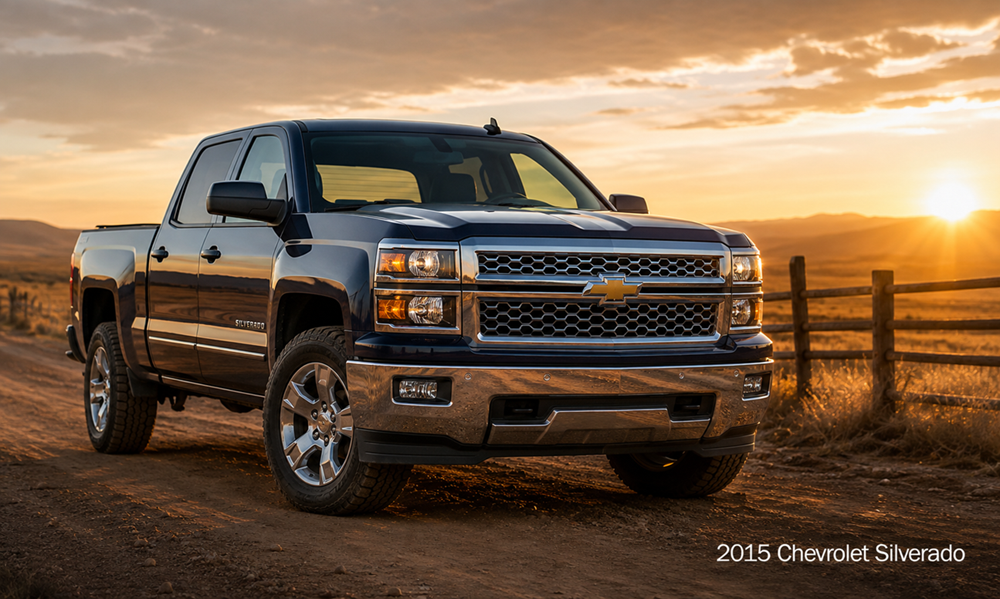
A decade-old Silverado can still be a useful work truck, tow rig, or daily driver, but condition and service history now matter more than trim badges or mileage alone.
The 2015 Chevrolet Silverado 1500 sits in an interesting spot in the used-truck market. It belongs to the generation that brought a quieter cabin, direct-injected EcoTec3 engines, available 4G LTE connectivity, and a broad range of work and luxury trims. For 2015, Chevrolet also paired the 6.2-liter V8 with a new eight-speed automatic, a combination that made the half-ton unusually quick for its time. Today, however, the buying decision is less about its original road-test numbers and more about whether a specific truck has aged well.
This guide focuses on the Silverado 1500, not the heavier 2500HD or 3500HD. It uses a three-gate buying test: identify the exact configuration, verify the mechanical condition, and decide whether the price makes sense in the 2026 market.
Key Takeaways
- The 2015 Silverado 1500 came with a 4.3-liter V6, 5.3-liter V8, or 6.2-liter V8. The 6.2 received the 8L90 eight-speed automatic for 2015, while the 4.3 and 5.3 used a six-speed automatic.
- For most used buyers, the 5.3-liter V8 remains the easiest configuration to shop because it balances power, availability, towing ability, and parts support.
- The 5.3 and 6.2 engines deserve a careful warm-idle check for misfire or valvetrain ticking because GM issued service information addressing collapsed Active Fuel Management lifters on some 2014-2015 trucks.
- A 6.2-liter truck needs an especially careful transmission road test. GM issued a 2015 service update for torque-converter-clutch shudder on certain 8L90-equipped vehicles.
- In 2026, current valuation guides put many dealer-retail examples roughly in the low five figures to around $20,000, depending heavily on cab style, trim, mileage, condition, drivetrain, and region.
- Do not trust a generic towing-capacity number. The truck’s axle ratio, cab, bed, drivetrain, Max Trailering Package, payload label, hitch, and trailer tongue weight all affect what a specific VIN can safely tow.
Gate 1: What 2015 Silverado Are You Actually Looking At?
The same model year can describe very different trucks. Chevrolet sold the Silverado 1500 as Regular Cab, Double Cab, and Crew Cab models, with multiple bed lengths, rear-wheel drive or four-wheel drive, and trims ranging from basic WT work trucks to LTZ and High Country luxury versions. That variety is why a listing that says only “2015 Silverado” is not enough information to judge value or capability.
| Engine | Power | Torque | 2015 Transmission | Best Fit Today |
| 4.3L EcoTec3 V6 | 285 hp | 305 lb-ft | 6-speed automatic | Light-duty use, lower purchase cost |
| 5.3L EcoTec3 V8 | 355 hp | 383 lb-ft | 6-speed automatic | Best all-around used-market choice |
| 6.2L EcoTec3 V8 | 420 hp | 460 lb-ft | 8-speed automatic | Maximum performance and towing potential |
Chevrolet’s archived 2015 Silverado 1500 specifications confirm those engine outputs and show how axle ratio and equipment change payload and trailering limits.
Which engine is the smartest buy in 2026?
The 4.3-liter V6 is enough for commuting, hardware-store runs, and lighter work, but it is not the configuration to chase if regular heavy towing is part of the plan. The 5.3-liter V8 is the volume engine and usually the easiest to find in LT, LTZ, and Z71 trucks. Its 355 horsepower and 383 lb-ft of torque are still adequate for everyday half-ton duties.
The 6.2-liter V8 is the enthusiast choice. Car and Driver recorded 0 to 60 mph in 5.7 seconds from a 2015 High Country 4×4 with the 420-hp engine and eight-speed automatic. That performance is impressive even by newer-truck standards, but the 6.2 configuration should be bought for its condition and maintenance history, not because it is the fastest version.
Gate 2: Can the Powertrain Pass a Cold-Start and Road-Test Audit?
At 11 years old, a clean dashboard and shiny paint cannot tell you whether a Silverado is a good buy. Start the truck cold if possible, let it reach operating temperature, then drive it in city traffic and at highway speed. A seller who has already warmed the truck before you arrive is not automatically hiding a problem, but it removes one of the most useful inspection opportunities.
What should you listen for from the 5.3L and 6.2L V8s?
Listen for a persistent valvetrain tick, rough idle, misfire, flashing or stored check-engine light, or obvious loss of power. GM service bulletin 15-06-01-002 documented a condition on some 2014-2015 trucks with the 5.3L L83 and 6.2L L86 engines in which an Active Fuel Management lifter could become mechanically collapsed or stuck, potentially producing a tick, misfire, and P0300 code. A bulletin does not mean every truck will fail, but it is a reason to take unexplained ticking or misfire seriously.
A pre-purchase scan is worthwhile even when no warning light is illuminated. Ask the technician to look for current, pending, and history codes and to check misfire data. Service invoices for prior valvetrain work are far more useful than a seller simply saying “the lifters were done.”
How should the transmission feel?
A healthy transmission should engage Drive and Reverse promptly and shift without repeated flare, shudder, banging, or hesitation. The 6.2-liter Silverado’s 8L90 deserves extra attention. GM issued a 2015 service update for certain 8L90-equipped Silverados because transmission calibration could contribute to excessive torque-converter-clutch energy and a shudder sensation. Later litigation also alleged shudder and harsh-shift problems across a wider group of GM eight-speed vehicles.
Do not diagnose an expensive transmission from one odd shift on a short test drive. Fluid temperature, calibration, tire size, previous repair work, and driveline condition can all affect feel. The right move is to have a shop experienced with GM trucks road-test the vehicle and inspect the fluid, leak points, and scan data before purchase.
What else should be checked underneath?
- Frame and body mounts for heavy scaling, perforation, or fresh coating that could be hiding corrosion, especially in snow-belt states.
- Front differential, rear differential, transfer case, transmission, engine, and cooling system for leaks or signs of neglected service.
- Four matching tires with similar tread depth. Mismatched tire diameters can create unnecessary stress in a four-wheel-drive system.
- Wheel bearings, ball joints, tie rods, shocks, CV axles, U-joints, and driveshaft for looseness, vibration, clunks, or torn boots.
- Brake lines, calipers, rotors, parking brake operation, and trailer-brake controller if equipped.
- Air conditioning performance, infotainment functions, power accessories, backup camera, parking sensors, and heated or ventilated seats on higher trims.
Gate 3: Is the Asking Price Supported by the Truck, Not the Ad?
Used-truck pricing can vary by thousands of dollars for the same model year. In 2026, Kelley Blue Book’s national Fair Purchase Price ranges show how much cab style alone can move the market. Its current figures place many 2015 Silverado 1500 Regular Cab examples around $9,000 to the mid-$16,000s, Double Cabs roughly in the low-$12,000s to upper-$17,000s, and Crew Cabs roughly in the low-$12,000s to about $20,000, before accounting for the exact ZIP code, mileage, condition, engine, drivetrain, options, or accident history.
Use a live valuation tool such as Kelley Blue Book’s 2015 Silverado 1500 value page immediately before negotiating because used values change by region and over time.
| Price signal | How to interpret it |
| Below local market | Possible bargain. Verify title, rust, mileage, and mechanical history. |
| At local market | Fair if records and condition support the price. |
| Above local market | Needs low mileage, excellent condition, desirable options, or major documented work. |
| “New engine/transmission” premium | Pay extra only with invoices showing parts, installer, mileage, and warranty. |
How Much Can a 2015 Silverado 1500 Tow?
The headline answer is “up to 12,000 pounds,” but that number belongs only to specific properly equipped configurations. Chevrolet’s original SAE J2807 trailering tables show, for example, a 2WD Double Cab with the 6.2L V8, 3.42 axle, and Max Trailering Package rated up to 12,000 pounds. A 4WD Crew Cab with the same engine can carry a lower rating depending on bed length and axle setup. The 4.3L V6 can be thousands of pounds lower.
For a used truck, the door-jamb payload label is just as important as the tow chart. Passenger weight, cargo, accessories, hitch hardware, and trailer tongue weight all consume payload. Before buying a Silverado specifically for a travel trailer or equipment trailer, verify the VIN configuration, axle ratio, receiver rating, payload label, brake controller, and the trailer’s loaded weight rather than its empty advertised weight.
Which Trim Should You Target?
At this age, the best trim is often the best-maintained truck. Still, each level attracts a different buyer. A WT or LS can make sense as a basic work truck because there is less luxury equipment to age. An LT often hits the practical sweet spot with better cabin features without the price of a premium trim. Z71-equipped trucks add off-road-oriented hardware and styling, but a Z71 badge should not excuse worn suspension parts or evidence of hard off-road use.
LTZ and High Country models bring leather, upgraded infotainment, more power accessories, and available driver-assistance features. They can feel much more modern inside, but every extra motor, module, screen, sensor, and seat function is another item to verify during inspection. On an 11-year-old truck, condition beats equipment count.
What Are the Biggest Walk-Away Signs?
- Persistent warm-engine tick plus a misfire or P0300-related history with no documented diagnosis.
- Repeated transmission shudder, slipping, flare, delayed engagement, or hard shifts that the seller dismisses without repair records.
- Serious structural rust, patched frame areas, crushed cab mounts, or corrosion around suspension and brake-line mounting points.
- Different tire sizes or badly uneven tread on a 4WD truck, especially with driveline noise or binding.
- A towing story that does not match the truck’s equipment. Heavy trailer use without a brake controller, service history, or appropriate hitch deserves extra scrutiny.
- A rebuilt or replacement engine or transmission with no invoice, no part number, no installer information, and no transferable warranty paperwork.
- Open safety recalls that the seller refuses to address or a VIN history that conflicts with the listing.
Before money changes hands, run the VIN through the official NHTSA recall lookup. The 2015 Silverado family has been involved in multiple safety campaigns over its life, and only a VIN-specific lookup can show whether a particular truck still has an unrepaired recall.
Is a 2015 Chevrolet Silverado Still a Good Truck in 2026?
Yes, a good one can be. The 2015 Silverado 1500 still offers a quiet cabin, straightforward controls, strong V8 performance, useful bed and cab combinations, and towing capability that remains relevant. The 5.3L trucks are plentiful, replacement parts and repair knowledge are widespread, and the platform can serve well when previous owners maintained it correctly.
The catch is that buying by reputation alone is risky. Eleven years of towing, winter salt, deferred fluid changes, oversized tires, short-trip use, modifications, or poor repairs can matter more than whether the odometer reads 90,000 or 140,000 miles. A higher-mileage one-owner truck with complete records can be a better purchase than a lower-mileage truck with an unknown history.
Frequently Asked Questions
How many miles is too many for a 2015 Silverado?
There is no universal cutoff. At this age, service history and inspection results matter more than a single mileage number. Once mileage climbs into six figures, budget for wear items and insist on evidence that the transmission, cooling system, driveline, brakes, suspension, and ignition system have not simply been ignored.
Is the 5.3L V8 better than the 6.2L V8 for a used buyer?
For many buyers, yes. The 5.3L provides strong everyday performance and is easier to find. The 6.2L is considerably more powerful and can unlock the highest trailering ratings, but 2015 6.2L trucks also bring the 8L90 eight-speed automatic, making transmission condition an especially important part of the purchase decision.
Should you buy a modified Silverado?
Only when the modifications are documented and professionally executed. Suspension lifts, oversized wheels, tuning, exhaust changes, cylinder-deactivation modifications, and towing upgrades can change how the truck drives and what components wear. Ask who performed the work, what parts were used, whether calibration changes were made, and whether the truck can still pass local inspection requirements.
What is the best pre-purchase inspection for this truck?
A cold start followed by a full scan, underbody inspection, fluid and leak check, four-wheel-drive operation test, and extended road test is the minimum. For a truck you plan to tow with, have the shop also verify the axle ratio, hitch and brake-controller operation, payload label, tire ratings, and any modifications that could affect capacity or stability.
The Bottom Line
The 2015 Chevrolet Silverado 1500 can still make financial sense in 2026, especially for buyers who want a traditional naturally aspirated truck without paying late-model prices. The strongest purchases are not necessarily the cheapest or lowest-mileage examples. They are the trucks that can prove what they are, how they were maintained, what has already been repaired, and why the asking price is justified.
If the VIN checks out, the frame is solid, the engine is quiet and smooth when warm, the transmission behaves properly, and the service history matches the seller’s story, a 2015 Silverado can still have useful life ahead. If those pieces do not line up, there are enough of these trucks on the U.S. used market that walking away is usually the smarter move.