A field-guide look at Z71 pricing, engines, 4WD hardware, towing, cabin space, suspension options, and the buyers who should choose it over RST or High Country.
The 2026 Chevy Tahoe Z71 occupies an unusual spot in the full-size SUV market. It is big enough to carry a family and their luggage, strong enough to tow a serious trailer, and comfortable enough for long highway trips, yet it adds real off-road hardware instead of relying on rugged-looking trim.
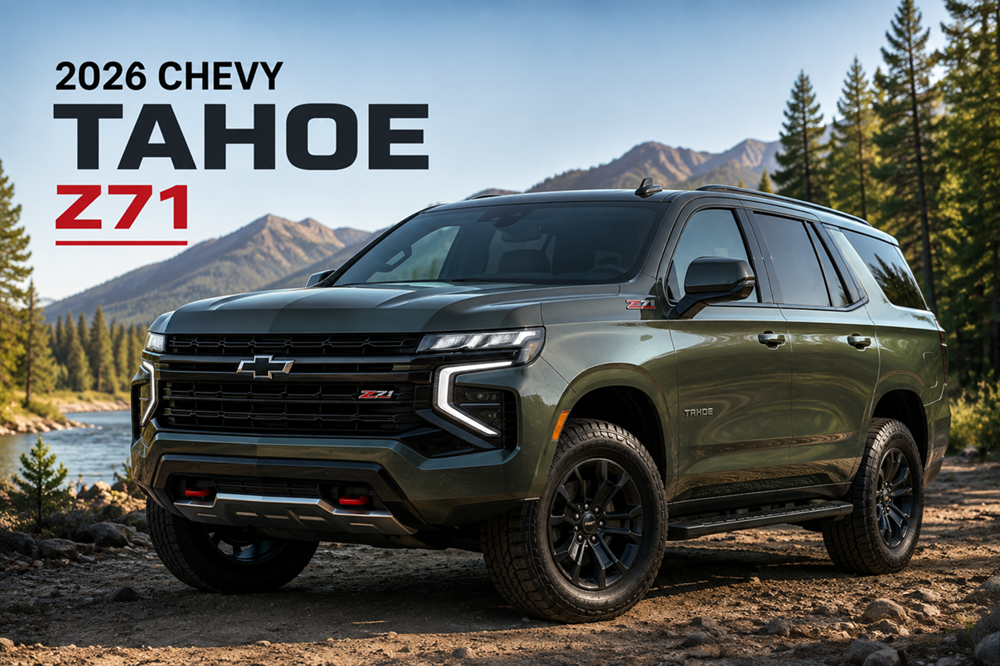
That distinction matters. The Z71 is not simply an appearance package. It is the only Tahoe trim that comes standard with four-wheel drive, an Autotrac two-speed transfer case, a high-approach front fascia, an aluminum skid plate, red recovery hooks, and all-terrain-focused hardware. Buyers can also add Four-Corner Air Ride Adaptive Suspension for extra ground clearance and better control over ride height.
That is why Car and Driver’s 2026 Tahoe buying guide treats the Z71 as the trim to consider when off-pavement ability matters. The more interesting question is whether its hardware is useful enough for your life to justify choosing it over the less rugged RST, the cheaper LT, or the more luxurious High Country.
| KEY TAKEAWAYS
· Chevrolet lists the 2026 Tahoe Z71 from $70,700 before the $2,795 destination charge, or $73,495 with destination. · Four-wheel drive is standard on Z71, along with an Autotrac two-speed transfer case, Hill Descent Control, underbody protection, red recovery hooks, and a high-approach front fascia. · The standard 5.3-liter V8 makes 355 hp and 383 lb-ft. A 420-hp 6.2-liter V8 and 305-hp, 495-lb-ft 3.0-liter Duramax diesel are available. · When properly equipped, a 4WD Tahoe can tow up to 8,200 pounds with the 5.3-liter V8 and Max Trailering Package. The 6.2-liter 4WD tops out at 8,100 pounds, while the diesel 4WD reaches 8,000 pounds. · Available air suspension can raise maximum ground clearance to about 10 inches and improve the Z71’s approach, breakover, and departure geometry. · The Z71 keeps the Tahoe’s full three-row practicality, including 25.5 cubic feet behind the third row and 122.7 cubic feet with the rear rows folded. |
Start With the Price: What Does a 2026 Tahoe Z71 Really Cost?
Chevrolet advertises the 2026 Tahoe Z71 at a starting MSRP of $70,700. The current destination freight charge is $2,795, so the practical starting figure is $73,495 before tax, registration, dealer fees, accessories, or optional equipment.
That puts the Z71 above the RST in the Tahoe hierarchy, but below Premier and High Country. The price jump buys more than styling because the Z71 starts with 4WD and adds off-road-specific body and chassis equipment.
The danger is option creep. A Z71 can move from the low-$70,000 range into the $80,000s surprisingly quickly once you add the larger engine, premium interior packages, panoramic roof, rear entertainment, upgraded suspension, trailering hardware, and dealer accessories.
For that reason, the Z71 makes the most sense when you buy it for its chassis advantages. If you mainly want black trim, big wheels, and a sporty appearance, the RST may be a more logical place to start.
The Three-Engine Decision: Which Powertrain Fits the Z71?
Unlike many off-road trims that force buyers into one engine, the Tahoe Z71 can be configured three different ways. All are paired with a 10-speed automatic transmission.
| Engine | Power | Torque | Status | Best For |
| 5.3L EcoTec3 V8 | 355 hp | 383 lb-ft | Standard | Best value, regular use |
| 6.2L EcoTec3 V8 | 420 hp | 460 lb-ft | Available | Best acceleration and V8 power |
| 3.0L Duramax turbo-diesel I-6 | 305 hp | 495 lb-ft | Available | Best range and low-rpm torque |
5.3-Liter V8: The Sensible Default
The standard 5.3-liter V8 is enough engine for most Z71 owners. Its 355 hp does not make the Tahoe feel small, but the power delivery is predictable and well suited to commuting, road trips, moderate towing, and low-speed trail use.
It also gives the Z71 its strongest maximum tow rating when the correct trailering equipment is installed. If you do not need the extra acceleration of the 6.2 or the range of the diesel, the 5.3 is the easiest engine to justify financially.
6.2-Liter V8: The Performance Choice
The optional 6.2-liter V8 increases output to 420 hp and 460 lb-ft. The difference is most noticeable when merging, passing, climbing grades, or moving a fully loaded Tahoe.
Car and Driver recorded 5.8 seconds from 0 to 60 mph in a current-generation Tahoe High Country with the 6.2-liter V8. A Z71 will not necessarily duplicate that exact result because equipment and weight differ, but the test shows how much performance the larger V8 can deliver in this platform.
The tradeoff is fuel use. A 4WD Tahoe with the 6.2 is generally rated around 14 mpg city and 18 mpg highway. If most of your miles are short urban trips, the fuel bill can become one of the largest ownership costs.
3.0-Liter Duramax: The Long-Distance Choice
The Duramax diesel produces less horsepower than either V8 but the most torque, with 495 lb-ft. It is especially attractive for long highway trips, steady towing, and buyers who want to stretch the distance between fuel stops.
Chevrolet advertises up to 624 miles of EPA-estimated highway range per tank for properly configured diesel Tahoes. A 4WD diesel Z71 is commonly rated around 20 mpg city and 24 mpg highway, significantly better than the gas V8s.
The diesel is not automatically the cheapest engine to own because diesel fuel prices, maintenance, emissions equipment, and option cost all matter. It is best for buyers who genuinely benefit from its torque and highway efficiency.
What Makes the Z71 Different Off-Road?
The Z71’s advantage begins at the front bumper. Chevrolet gives it a high-approach-angle fascia that leaves more open space ahead of the front tires. That reduces the chance of the bumper contacting a steep incline before the tires reach it.
An aluminum skid plate protects vulnerable components, while the red front recovery hooks give a clear attachment point for recovery situations. Black tubular assist steps are standard, and the Autotrac two-speed transfer case provides low-range gearing for more controlled crawling, steep descents, and difficult low-speed terrain.
Hill Descent Control helps manage speed on steep grades so the driver can concentrate on steering. The 20-inch wheels and all-terrain tires are a better starting point for dirt, snow, gravel, and rocky roads than the huge street-oriented wheel packages available on some other Tahoe trims.
Chevrolet’s current 2026 Tahoe Z71 overview specifically highlights the skid plate, recovery hooks, high-approach fascia, two-speed transfer case, and available Four-Corner Air Ride Adaptive Suspension as the trim’s defining hardware.
Is the Air Suspension Worth Adding?
For buyers who will actually use the Z71 on rough roads or uneven trails, the available Four-Corner Air Ride Adaptive Suspension is one of the most meaningful upgrades.
At normal ride height, the current Tahoe platform provides about 8 inches of minimum ground clearance. In its maximum raised position, Air Ride can increase that to about 10 inches. The system can also improve obstacle clearance by changing the approach, breakover, and departure geometry.
The benefit extends beyond trails. Air suspension can lower the vehicle for easier entry and loading, then adjust ride height based on conditions. When combined with Magnetic Ride Control in the more comprehensive off-road suspension package, the Tahoe becomes noticeably more sophisticated than a basic body-on-frame SUV.
There is a long-term tradeoff: air suspension adds mechanical and electronic complexity. Buyers planning to keep the Tahoe for many years should weigh that against the real value they will get from adjustable ride height.
How Much Can a Tahoe Z71 Tow?
A common mistake is to quote the Tahoe’s overall 8,400-pound maximum as if every trim can achieve it. The Z71 is 4WD only, so its realistic maximums are slightly different.
According to Chevrolet’s 2026 Trailering Guide, the maximum ratings for a properly equipped 4WD Tahoe are:
| Engine | Standard Max Tow | With Max Trailering |
| 5.3L V8 | 7,700 lb | 8,200 lb |
| 6.2L V8 | 7,600 lb | 8,100 lb |
| 3.0L Duramax | 7,900 lb | 8,000 lb |
Those numbers are maximum ratings, not automatic permissions to load any trailer to that weight. Passengers, cargo, dealer accessories, options, tongue weight, and the vehicle’s actual door-jamb payload rating all affect what your specific Tahoe can safely tow.
For frequent trailering, the Max Trailering Package is more important than chasing the largest engine. It adds hardware and cooling support intended for heavier trailer use.
How Practical Is the Z71 as a Family SUV?
This is where the Tahoe separates itself from smaller off-road SUVs. The Z71 does not require buyers to sacrifice three-row space for trail hardware.
Chevrolet lists 25.5 cubic feet of cargo space behind the third row, 72.5 cubic feet behind the second row, and 122.7 cubic feet behind the first row. The third row has 34.9 inches of legroom, which is enough to make it genuinely useful rather than an emergency-only seat.
Depending on seating configuration, Tahoe can carry up to eight passengers in mainstream retail versions, while the broader Tahoe range can be configured for as many as nine. Second-row captain’s chairs are popular on heavily optioned Z71 models because they improve third-row access, but the bench is the better choice if total seating capacity matters.
For buyers carrying a family plus camping gear, the main limitation is the 25.5-cubic-foot space behind the third row. It is good for a full-size SUV, but a Suburban is still the better Chevrolet if you routinely travel with every seat occupied and a large amount of luggage.
What Is the 2026 Tahoe Z71 Interior Like?
The 2025 refresh transformed the Tahoe’s dashboard, and the 2026 model carries that layout forward. A 17.7-inch center touchscreen dominates the dash, paired with an 11-inch digital driver display. Wireless Apple CarPlay and Android Auto are built into the infotainment system.
The wide screen layout makes camera views especially useful in a Z71. A full-size SUV that is easy to place on a highway can feel enormous on a narrow trail or in a parking garage, so surround-view and trailering camera technology can be more valuable than another cosmetic option.
The cabin also benefits from the Tahoe’s independent rear suspension, which helps create a low and relatively flat cargo floor. The result is a vehicle that feels more like a family SUV inside even though its chassis and tow ratings remain truck-like.
Does the Z71 Get Super Cruise?
This is an important trim-selection detail. Chevrolet promotes Super Cruise on the Tahoe range, but availability is tied to selected trims and packages. Current 2026 information lists Super Cruise availability on LT, RST, Premier, and High Country rather than Z71.
If hands-free highway driving is a must-have feature, verify the exact build before placing an order. A buyer who values Super Cruise more than low-range off-road hardware may be better served by an RST or Premier with 4WD.
Z71 vs RST: Which One Should You Buy?
The RST and Z71 often attract the same buyer because both have a more aggressive look than LT or Premier. Their priorities are different.
| Feature | Z71 | RST |
| Drivetrain | 4WD standard | 2WD standard, 4WD available |
| Two-speed transfer case | Standard | Not the defining feature |
| Skid plate / recovery hooks | Standard Z71 hardware | No Z71 front-end setup |
| High-approach fascia | Yes | No |
| Street styling | Rugged | Sporty / blacked-out |
| Super Cruise availability | Not currently listed | Available |
| Best buyer | Trails, snow, rough access roads | Road-focused appearance and tech |
Choose Z71 if the Tahoe will see snow-covered mountain roads, beaches, hunting trails, muddy property access, forest roads, or other surfaces where low range and better clearance can be useful.
Choose RST if you mostly drive pavement and want a more aggressive appearance, larger wheel options, and access to technology such as Super Cruise.
Z71 vs High Country: Capability or Luxury?
High Country is the more luxurious Tahoe and includes the 6.2-liter V8 as standard. It adds premium materials and more upscale features, but it does not start with the Z71’s high-clearance front fascia and off-road-focused recovery hardware.
A heavily optioned Z71 can approach High Country money. At that point, the decision should come down to use rather than features per dollar.
If you regularly leave pavement, the Z71’s body geometry and low-range hardware are difficult to recreate cleanly on a High Country. If you rarely go beyond maintained gravel roads, High Country gives you the richer interior and more complete luxury experience.
What Should You Add, and What Can You Skip?
Add It: Max Trailering Package
If you tow anything substantial, this is one of the most useful upgrades. It raises the relevant 4WD Tahoe maximum tow rating and adds equipment designed around trailer use.
Consider It: Four-Corner Air Ride Adaptive Suspension
Worth considering for buyers who want extra trail clearance, easier entry, and a more sophisticated ride-height system. It makes less financial sense if the Tahoe will never leave paved roads.
Consider It: 6.2-Liter V8
Buy it for performance, not necessity. The 5.3 can handle normal family use and towing. The 6.2 simply makes the Tahoe feel much quicker and stronger.
Consider It: Duramax Diesel
A strong choice for long-distance drivers and owners who tow regularly. Its highway range is the main attraction. Short-trip urban users may not benefit enough to justify choosing diesel.
Think Twice: Oversized Street Wheels
Large wheels can look impressive, but they work against the reason to buy a Z71. More tire sidewall generally helps ride comfort and protects wheels on rough surfaces. If off-road use matters, keep the tire and wheel package aligned with that mission.
Who Should Buy the 2026 Tahoe Z71?
The Z71 is at its best for a specific kind of buyer: someone who needs a full-size family SUV but routinely drives in conditions that expose the limitations of road-focused crossovers.
- Families who tow boats, campers, utility trailers, or powersports equipment.
- Drivers in snowy or mountainous regions who value a true two-speed 4WD system.
- Campers, hunters, and outdoor users who regularly travel on rough forest or access roads.
- Rural owners who deal with dirt, mud, washouts, and uneven property roads.
- Buyers who need three usable rows but still want legitimate recovery and underbody protection hardware.
It is less compelling for buyers who simply like the Z71 look. If the vehicle will live almost entirely on pavement, an LT or RST can deliver the same basic space, screen technology, engine choices, and road manners for less money or with different luxury features.
Frequently Asked Questions
How much is a 2026 Chevy Tahoe Z71?
Chevrolet currently lists the Z71 from $70,700 before destination. With the $2,795 destination charge, the starting figure is $73,495 before taxes, fees, options, and accessories.
Is the 2026 Tahoe Z71 4WD?
Yes. Unlike most Tahoe trims, Z71 comes standard with four-wheel drive and an Autotrac two-speed active transfer case.
What engine comes standard in the Tahoe Z71?
The standard engine is the 5.3-liter EcoTec3 V8 with 355 hp and 383 lb-ft of torque. The 6.2-liter V8 and 3.0-liter Duramax turbo-diesel are available.
How much can a 2026 Tahoe Z71 tow?
Because Z71 is 4WD, its maximum depends on engine and equipment. A properly equipped 5.3-liter 4WD Tahoe can tow up to 8,200 pounds with the Max Trailering Package. The equivalent maxima are 8,100 pounds for the 6.2 and 8,000 pounds for the diesel.
Is the Tahoe Z71 good off-road?
For a full-size three-row SUV, yes. It has low-range 4WD, skid protection, recovery hooks, all-terrain-oriented equipment, Hill Descent Control, and a high-approach front fascia. It is still a large and heavy vehicle, so tight technical trails are not its ideal environment.
Does the Tahoe Z71 have air suspension?
Four-Corner Air Ride Adaptive Suspension is available rather than standard. It can raise the vehicle for additional ground clearance and lower it for easier entry and loading.
How much cargo space does the Tahoe have?
Chevrolet lists 25.5 cubic feet behind the third row, 72.5 cubic feet behind the second row, and 122.7 cubic feet behind the first row.
Final Verdict: Z71 Is the Tahoe With a Purpose
The 2026 Chevy Tahoe Z71 is easy to understand once you stop viewing it as an appearance trim. Its purpose is to add real low-speed 4WD capability, better front clearance, recovery points, skid protection, and off-road-oriented equipment to a full-size family SUV.
The standard 5.3-liter V8 is the value choice, the 6.2-liter V8 is the performance choice, and the Duramax diesel is the range and torque choice. Buyers who tow should prioritize the Max Trailering Package, while those who genuinely use rough terrain should give serious consideration to the available air suspension.
For most people who never leave pavement, RST or LT can be the smarter buy. But if your family SUV also has to pull a trailer to a remote campsite, climb a snowy access road, cross washouts, or handle rough property roads, the Z71’s extra hardware is not decoration. It is the reason to choose this Tahoe.
Pricing, specifications, cargo figures, and trailering ratings were checked against current U.S. Chevrolet information available in August 2026. Manufacturer pricing, incentives, destination charges, equipment, and tow ratings can vary by configuration and may change.